Icelanders have rejected a proposal to restart negotiations on European Union membership, delivering a significant setback to supporters of closer integration with the EU.
The vote comes after years of debate over whether the North Atlantic island should remain outside the European Union or reconsider membership as Europe faces growing economic and geopolitical pressures.
Iceland is already closely connected to the European economy through the European Economic Area (EEA), which gives it access to the EU’s single market without requiring full EU membership. It is also part of the Schengen Area, allowing passport-free travel within much of continental Europe.
For supporters of EU membership, however, those arrangements do not provide Iceland with a seat at the table when major European decisions are made.
The referendum therefore represented more than a question about EU membership. It was also a debate about national sovereignty, economic independence and Iceland’s place in an increasingly integrated Europe.
Why does Iceland matter to the EU?
Iceland is a small country of roughly 400,000 people, but its strategic location gives it importance far beyond its population.
Situated in the North Atlantic between Europe and North America, Iceland occupies a strategically important position for shipping, communications and military security. Its location has become increasingly significant as tensions between Russia and Western countries have intensified.
Iceland is also a member of NATO, although it does not maintain a conventional standing army.
For the EU, closer ties with Iceland could strengthen Europe’s position in the North Atlantic and deepen cooperation on energy, fisheries, security and trade.
Why do some Icelanders oppose EU membership?
One of the strongest arguments against membership is sovereignty.
Iceland has historically placed enormous importance on controlling its own affairs, particularly its fishing industry. Fisheries are a crucial part of the country’s economy, and many Icelanders fear that EU membership could reduce their ability to independently determine fishing quotas and manage their waters.
There are also concerns about adopting EU policies that may not always reflect Iceland’s specific economic and geographic circumstances.
For opponents, remaining outside the EU allows Iceland to maintain greater control over its natural resources while still benefiting from access to European markets.
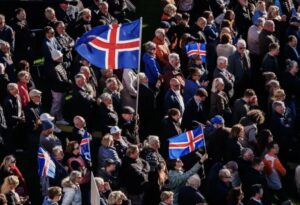
But there are advantages to joining
Supporters of EU membership argue that Iceland could gain greater political influence by becoming a full member rather than remaining closely connected to the bloc from outside.
Membership would give Iceland representatives within EU institutions and a direct role in decisions affecting European policies.
There is also the question of economic stability.
Iceland’s economy is heavily exposed to international markets, tourism, fishing and other external factors. Supporters argue that EU membership could provide greater economic integration and potentially strengthen Iceland’s position during periods of uncertainty.
What does the vote mean for Europe?
The result is significant because it comes at a time when Europe is attempting to strengthen unity.
The war in Ukraine, tensions with Russia, uncertainty over transatlantic relations and changing global trade patterns have increased pressure on European countries to cooperate more closely.
Iceland’s decision demonstrates that European integration is not universally viewed as the answer to those challenges.
The result could also encourage other European countries and political movements that favour greater national independence from Brussels.
At the same time, Iceland’s continued relationship with the EU through the EEA means the country is unlikely to become economically disconnected from Europe.
What happens next?
For now, Iceland is expected to remain outside the European Union while continuing its extensive economic and political cooperation with the bloc.
The referendum does not mean Iceland is turning away from Europe. Rather, it reflects a preference for maintaining a relationship in which Iceland can benefit from European economic integration while retaining greater national control.
The bigger question is whether that position will remain sustainable as Europe becomes more strategically and economically integrated.
For Iceland, the vote is ultimately about finding a balance between the benefits of being closely connected to Europe and the desire to remain firmly in control of its own decisions.
For the EU, it is another reminder that deeper European integration remains a choice, not an inevitability.
Sources:
Reuters.com, Al Jazeera, Euronews.