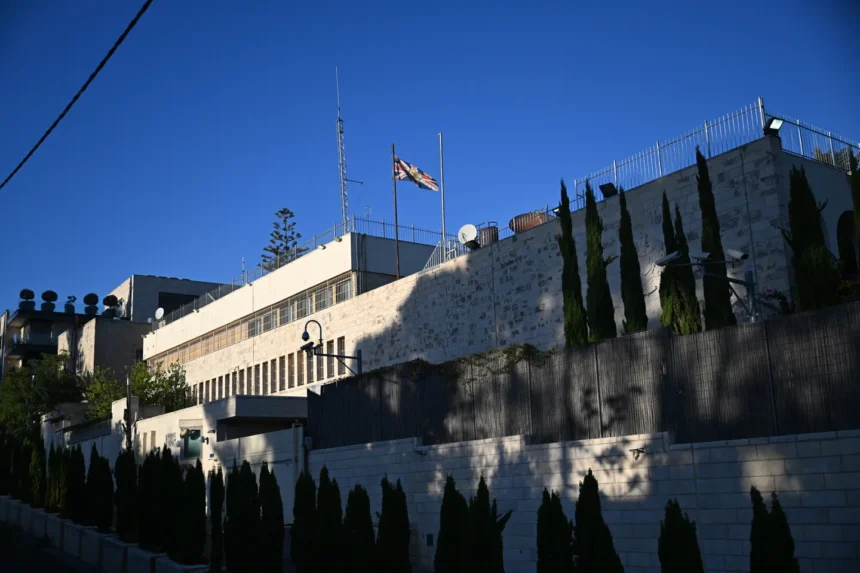
Israel has ordered Britain to close its Consulate General in East Jerusalem within 30 days, escalating an already strained relationship between the two countries. The decision came shortly after Britain and several other countries announced new measures against Israeli settlements in the occupied West Bank.
But why has a British diplomatic office become part of the dispute?
The story goes back decades.
The British Consulate in Jerusalem has existed since the 19th century, long before the creation of Israel in 1948. Today, it deals largely with Britain’s relations with Palestinians in East Jerusalem, the West Bank and Gaza. Its location is significant because the status of Jerusalem remains one of the most disputed issues in the Israeli-Palestinian conflict.
Israel considers Jerusalem its capital, while Britain and much of the international community do not recognise Israel’s sovereignty over East Jerusalem, which Israel captured during the 1967 Six-Day War. Britain maintains that the final status of Jerusalem should be decided through negotiations between Israelis and Palestinians.
Another major source of tension is Israel’s construction of settlements in the West Bank and East Jerusalem. Britain considers these settlements illegal under international law and argues that continued expansion makes it increasingly difficult to establish an independent Palestinian state alongside Israel.
The disagreement intensified in August when Israel moved forward with plans for development in E1, an area between Jerusalem and other parts of the West Bank. Britain warned that the project could make a future Palestinian state much harder to achieve.
Tensions between London and Jerusalem had already been growing since the Israel-Hamas war began in 2023. Britain has previously restricted some arms exports to Israel, sanctioned individuals linked to settler violence and taken other measures over the situation in Gaza and the West Bank. Britain also formally recognised the State of Palestine in 2025, saying it wanted to help preserve the possibility of a two-state solution.
Then, on September 8, Britain announced new restrictions targeting Israeli settlements, including a ban on imports of goods produced in settlements in the occupied West Bank. Britain stressed that the measures were aimed at the settlements, not at Israel as a whole.
Israel did not take kindly to this new development.
Israel reacted strongly. Foreign Minister Gideon Sa’ar announced that Britain would have to close its consulate in East Jerusalem. Israel accused Britain of interfering in its internal affairs and attempting to pressure it over issues that Israel believes should be settled through direct negotiations.
Israel also announced other measures, including removing Britain from a US-led Gaza coordination role, ending Britain’s training of Palestinian Authority security forces and barring 12 British nationals from entering Israel.
What does the closure actually mean?
Britain’s consulate has not simply shut down overnight. Israel has given Britain 30 days to close it, meaning the diplomatic operation will be wound down during that period.
The move also does not mean Britain and Israel have broken diplomatic relations. Britain’s main embassy in Israel remains in Tel Aviv.
Instead, Israel is specifically targeting Britain’s long-standing diplomatic presence in East Jerusalem, an office closely connected to Britain’s work with Palestinians and its position on the disputed status of the city.
Why this matters
The closure is the latest sign of how terribly Britain’s relationship with Israel has deteriorated. What began as disagreements over Gaza and Israeli settlements has increasingly expanded into disputes over Palestinian statehood, Jerusalem, international law and the future of the West Bank and for now, Britain has 30 days to close a diplomatic office that has represented its interests in Jerusalem for nearly two centuries.