
Imagine being arrested because you told someone about Jesus Christ.
Imagine gathering your family to pray, only to discover that your religious activities have attracted police attention.
Imagine accepting Jesus Christ as your Lord and Saviour, but having to hide your Bible, conceal your faith and live in fear because the government treats your decision as a threat.
For millions of people living under restrictive religious laws, these are not imaginary situations.
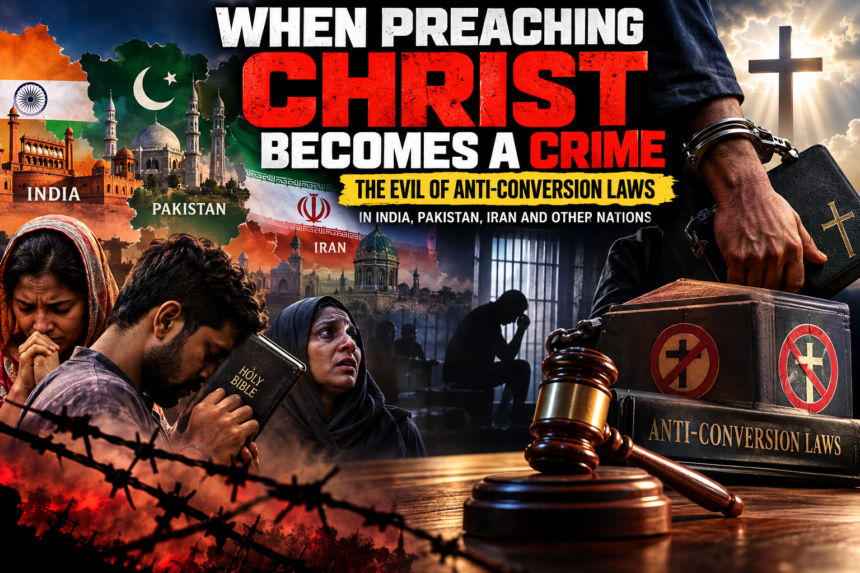
Across different nations, governments have established laws that restrict religious conversion, punish certain forms of evangelism and make it dangerous for individuals to leave one religion for another.
Some of these laws carry prison sentences stretching into decades. Others expose believers to the possibility of life imprisonment or even death.
And behind the legal language, an extremely disturbing question must be asked:
Since when did the government become the owner of a man’s soul?
Who gave politicians the authority to determine what another human being must believe about God?
And what kind of justice punishes a person for choosing to follow Jesus Christ?
This is where the evil of anti-conversion legislation must be exposed.
INDIA: WHEN CONVINCING SOMEONE ABOUT CHRIST CAN ATTRACT CRIMINAL CHARGES
India presents one of the most troubling examples of how religious restrictions can be written into law while carrying the attractive title of religious freedom.
Several Indian states have enacted laws officially intended to prevent religious conversions through force, fraud or improper inducement.
But there is a dangerous problem.
Some provisions are written so broadly that ordinary religious activities can become grounds for criminal accusations.
Consider Rajasthan.
Under the Rajasthan Prohibition of Unlawful Conversion of Religion Act, 2025, the prohibited methods include terms such as convincing, propaganda, allurement and online solicitation.
Violations of the law can attract imprisonment ranging from seven to fourteen years, while offences involving what the law defines as mass conversion can carry sentences of twenty years to life imprisonment.
Read that carefully.
Convincing. Propaganda. Online solicitation.
What happens when a Christian explains salvation to another person?
What happens when somebody hears the Gospel online and decides to become a Christian?
What happens when a preacher presents the Scriptures so clearly that his listener becomes convinced?
Where does legitimate preaching end and criminally prohibited convincing begin?
This is the danger of giving government officials broad powers over matters of personal faith.
The situation in Chhattisgarh is equally disturbing.
Its Freedom of Religion Act, which came into force in July 2026, provides for imprisonment of up to life for certain offences involving mass conversion. Even individuals seeking voluntary religious conversion must submit advance declarations to the authorities.
A person’s decision about God has effectively become a matter requiring government paperwork.
And this is precisely where legislation begins to interfere with a freedom that belongs to every human being.
Nobody should be prevented from freely accepting Christ.
PAKISTAN: WHEN SHARING YOUR FAITH CAN PUT YOUR LIFE IN DANGER
In Pakistan, the machinery of religious restriction operates differently.
Although the country does not have a general law explicitly prohibiting religious conversion, its blasphemy laws and the treatment of those who leave Islam create serious dangers for Christians.
Under Pakistan’s Penal Code, Section 295-C concerns derogatory remarks about the Prophet Muhammad and carries the death penalty.
Other provisions punish offences involving the Quran and religious sentiments.
These laws have repeatedly attracted concern because of false accusations, weak safeguards and their use in personal disputes.
Christians who share their faith with Muslims can face accusations of blasphemy, while converts from Islam may encounter severe threats and hostility.
Official assessments also confirm that Pakistan’s registration system permits changes of recorded religion to Islam but not from Islam to another faith.
Think about the injustice.
A person can decide to embrace one religion and receive official recognition.
But deciding to embrace another religion may mean losing the ability to have that decision recognised by the state.
What kind of religious freedom operates in only one direction?
When a person must choose between openly expressing faith in Christ and protecting his life, freedom has been severely wounded.
A society cannot claim to protect religion while making an individual’s sincere religious decision a source of danger.
IRAN: WHEN CONVERSION TO CHRISTIANITY BECOMES A SECURITY CONCERN
Iran provides another deeply troubling example.
The Iranian Constitution recognises certain historic Christian communities, including Armenian and Assyrian Christians.
However, Muslims who convert to Christianity face a very different reality.
Christian converts have been arrested, detained and prosecuted under accusations involving national security, unlawful religious activities and propaganda.
House churches have faced government raids, while religious gatherings and Christian evangelism can attract criminal investigation.
Iran’s amended criminal laws have also been used to prosecute Christians under provisions concerning religious teaching considered contrary to Islam.
Although apostasy is not expressly defined as an offence in Iran’s written penal code, its legal system and religious rules create serious risks for converts.
Some Christians have received lengthy prison sentences for activities connected with their faith.
Consider the frightening contradiction.A group of Christians gathers inside a home to worship God.
They sing. They pray. They study the Bible. Yet such activities can attract the attention of state security agencies.
How did prayer become a matter of national security?
How does accepting Jesus Christ become something a government must investigate?
These are questions every defender of human dignity must confront.
NEPAL: FIVE YEARS IN PRISON FOR UNLAWFUL PROSELYTISING
Nepal’s legal restrictions further demonstrate how governments can interfere with religious choices.
Section 158 of Nepal’s National Penal Code prohibits converting or attempting to convert another person under its specified provisions.
Violations can attract imprisonment of up to five years and a fine of 50,000 Nepalese rupees.
Foreigners convicted under the relevant provisions may also be deported after serving their sentences.
Five years!
A person could lose five years of freedom under laws regulating efforts to persuade another person to change religion.
And here lies the disturbing reality.
Governments are increasingly placing themselves between the preacher and the person who wants to hear the Gospel.
THE SATANIC INFLUENCE BEHIND UNRIGHTEOUS LAWS
The Bible provides a powerful warning concerning governments that establish laws designed to oppress people.
Isaiah 10:1–2 declares:
“Woe unto them that decree unrighteous decrees, and that write grievousness which they have prescribed.”
The passage goes further to condemn those who use injustice to rob the poor and deny vulnerable people their rights.
Notice something important.
God does not condemn only the person who physically commits injustice.
He also condemns those who create the legal instruments through which injustice is carried out.
This is the weaponization of the justice system. The law becomes the weapon.
The government becomes the enforcer.
And ordinary people become the victims.
From a biblical perspective, deliberately establishing systems that obstruct the Gospel and oppress believers reflects the workings of spiritual wickedness.
The Apostle Paul explains in Ephesians 6:12 that our struggle is not against flesh and blood, but against spiritual powers of darkness.
The real enemy is not the ordinary citizen of India, Pakistan, Iran or Nepal. It is the spiritual wickedness that seeks to turn human authority against God’s purposes.
The people of these nations deserve the Gospel, freedom, justice and salvation.
They are not the enemy.
The evil lies in systems that punish innocent people for exercising their faith and in the spiritual influences that promote such oppression.
PASTOR CHRIS OYAKHILOME: THE CHURCH CANNOT BE SUBJUGATED BY UNRIGHTEOUS LAWS
For years, Rev. Dr. Chris Oyakhilome has spoken forcefully against the establishment of oppressive laws and the influence of satanic powers over governmental systems.
His teaching has consistently emphasised that the Church of Jesus Christ is not a helpless organisation existing at the mercy of political authorities.
The Church is the body of Christ, established to fulfil God’s purpose in the earth.
During a global prayer and fasting programme, Pastor Chris explained that leaders could yield themselves to evil spiritual influences, resulting in oppressive governments and unjust decrees.
He called Christians to pray against such oppression and for the protection of their God-given rights.
In September 2026, during Your Loveworld Special, Season 12, Phase 4, Pastor Chris again addressed unjust laws and restrictions affecting the liberty to preach the Gospel.
He warned about the use of legislation, including certain hate-speech laws, to hinder the free proclamation of the Gospel.
He connected these developments to the agenda of the Antichrist and emphasised that the Church must not remain silent in the face of injustice.
Watching and praying against unrighteous laws, he taught, is a responsibility given to the Church by God.
His teachings carry a particularly powerful message when considered alongside the restrictions facing Christians in India, Pakistan, Iran and other nations.
The authority of Christ does not disappear because a government passes an oppressive law.
Jesus did not tell His disciples to preach the Gospel only in nations where political leaders approved of Christianity.
In Matthew 28:19, He commanded them to make disciples of all nations.
ALL NATIONS.
Not selected nations.
Not government-approved territories.
Not countries where preaching is politically convenient.
The commission of Christ is global.
And this is why the attempt to suppress the Gospel through legislation must be understood as far more than an ordinary political disagreement.
It is a direct challenge to the freedom of the Church to fulfil its divine assignment.
WHEN HUMAN LAWS CONFLICT WITH DIVINE INSTRUCTIONS
In Acts 4, the religious authorities commanded Peter and John not to speak or teach in the name of Jesus.
Their response was remarkable.
They refused to accept that human authority could erase their responsibility before God.
Later, in Acts 5:29, Peter and the other apostles declared:
“We ought to obey God rather than men.”
This was not a call to violence or disorder.
It was a declaration that no human institution possesses unlimited authority over a believer’s conscience.
That principle remains relevant today.
Governments have a responsibility to maintain peace, punish genuine wrongdoing and protect their citizens.
But they do not have the right to force people into religious belief or punish peaceful changes of faith.
A law used to intimidate Christians, suppress evangelism or punish someone for freely choosing Christ crosses a dangerous line.
You cannot claim to defend religious freedom by taking away the freedom to believe.
WHAT THE CHURCH MUST DO
The Church cannot treat the persecution of Christians as distant news.
When a believer faces imprisonment for his faith in one country, the global body of Christ has a responsibility to respond.
And this response must begin with spiritual understanding.
Pastor Chris has repeatedly taught the importance of praying for nations, leaders and the advancement of the Gospel.
Through global prayer programmes, fasting, teaching and coordinated intercession, Christians across the LoveWorld Nation and beyond have been mobilised to pray concerning unrighteous decrees and the activities of spiritual wickedness.
This work is significant because the Church does not fight merely against the visible systems of government.
It deals with spiritual matters through prayer while also standing for truth and righteousness in society.
Christians must therefore continue praying for persecuted believers, supporting those suffering injustice, defending religious liberty, making the Gospel available and calling for the removal of oppressive laws.
And the Church must pray for boldness.
Boldness for preachers.
Boldness for Christian families.
Boldness for lawyers and judges who defend justice.
Boldness for legislators who refuse to approve unrighteous decrees.
And boldness for leaders who will protect the rights of their people even when doing so is politically costly.
The Church must also recognise that unjust laws can be challenged and changed.
In October 2026, India’s Chhattisgarh High Court was asked to examine the constitutional validity of the state’s new anti-conversion legislation, demonstrating that opposition to such restrictions is also taking place through the courts.
These are important struggles, and believers must not become discouraged.
THE FINAL QUESTION: WHO OWNS THE SOUL OF MAN?
Governments may control borders.
They may issue passports.
They may regulate public institutions.
They may establish laws for the proper functioning of society.
But they do not own the human soul.
No parliament created the human spirit.
No president purchased humanity with his blood.
No government has the authority to determine whom a person must worship.
Jesus Christ died for humanity, and His Gospel is a message of salvation, not an offence against the state.
The tragedy of oppressive anti-conversion laws is that they attempt to make the freedom to believe dependent upon political approval.
They put fear where there should be liberty.
They turn religious convictions into police matters.
They expose innocent believers to punishment.
And they give human authorities powers over personal faith that no earthly institution should possess.
Isaiah 10 carries a solemn warning to those responsible for making unrighteous laws.
God does not celebrate injustice simply because it has been approved by a parliament.
And as Pastor Chris has taught, the Church is not a victim of the systems of this world.
We are victors in Christ.
We are called to pray, to stand for righteousness and to proclaim the Gospel with courage.
The laws of men must never be allowed to become instruments for destroying the freedoms God has given humanity.
A government may write a law against conversion, but it cannot write Jesus Christ out of the hearts of men.
It may threaten the preacher, but it cannot erase the truth of the Gospel.
It may attempt to silence the Church, but it cannot overthrow the Lordship of Jesus Christ.
And to every government that uses legislation to oppress innocent believers, the warning of Scripture remains unmistakable:
WOE UNTO THEM THAT DECREE UNRIGHTEOUS DECREES.
The Gospel is not a crime. Salvation is not a criminal offence. And the freedom to follow Jesus Christ is not a privilege that politicians have the authority to grant or withdraw.