

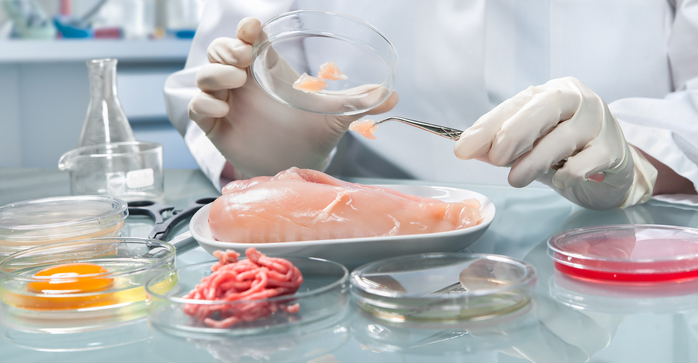
The food on our plates is changing.
For generations, food production has been closely connected to the land, farms, livestock and natural agricultural processes. Today, advances in biotechnology are creating a different approach, with companies developing foods and food ingredients in laboratories and highly controlled production facilities.
In the United States, the Food and Drug Administration has completed pre-market consultations for several foods made from cultured animal cells, including products involving chicken, pork fat and salmon.
The development is another sign of how quickly biotechnology is becoming part of the global food industry.
But as this technology advances, an important question deserves attention: What happens when food moves further away from the farm and closer to the laboratory?
THE RISE OF LAB-GROWN FOOD
Cultivated food is being developed as an alternative to conventional animal agriculture. Instead of depending entirely on traditional livestock production, scientists can use animal cells as the starting point for producing certain foods.
At the same time, precision fermentation is being used to manufacture specific food ingredients and proteins.
For the food industry, the attraction is clear. These technologies offer the possibility of producing food in controlled environments and potentially at large scale.
But food is more than a product coming out of a factory.
For centuries, agriculture has connected human nutrition to soil, plants, animals, water, sunlight and natural ecosystems. The increasing industrialisation of the food supply raises questions about what could be lost when those connections become less central to how food is produced.
WHY NATURALLY GROWN FOOD STILL MATTERS
Fresh fruits, vegetables, grains, legumes, nuts and other minimally processed foods remain important foundations of a healthy diet.
Organic farming also places greater emphasis on agricultural practices such as maintaining soil health, biodiversity and reducing reliance on certain synthetic inputs.
This does not mean that every food labelled organic is automatically healthier, or that conventional agriculture is inherently harmful. It does mean that there is value in maintaining food systems that support healthy soils, diverse crops and access to foods that are close to their natural form.
There is also something fundamentally different about eating food that comes from a farm rather than food designed and assembled through increasingly complex industrial processes.
As food technology becomes more sophisticated, preserving access to naturally produced and minimally processed foods becomes increasingly important.
WHAT COULD BE THE CONCERNS?
One of the biggest concerns is not necessarily that cultivated or precision-fermented foods are immediately proven to be harmful. It is that the technology is developing faster than our ability to understand every possible long-term consequence.
New food production methods can introduce unfamiliar ingredients, production processes and combinations that may require continued research.
Questions around nutritional composition, allergens, contaminants, processing and long-term consumption remain important areas of scientific investigation.
There is also the possibility that highly engineered foods could gradually become more dominant in the food market, particularly if they become cheaper and easier to manufacture than traditional agricultural products.
That could change consumer choices in ways that have consequences beyond nutrition.
COULD WE BECOME TOO DEPENDENT ON THE LABORATORY?
Food production has already become heavily industrialised.
Much of the modern food supply depends on large manufacturers, extensive processing and complex supply chains. The expansion of cellular agriculture and precision fermentation could take this even further.
If more of the food supply becomes dependent on sophisticated facilities, specialised technology and a small number of companies capable of producing these foods, questions about food security and control of the food supply will become increasingly relevant.
Who produces the food?
Who controls the technology?
Who controls the ingredients?
And what happens to traditional farmers if consumers and food manufacturers increasingly turn toward laboratory-produced alternatives?
These are not questions that can be answered simply by looking at whether a particular product is safe to eat.
WHAT SHOULD HAPPEN TO TRADITIONAL AGRICULTURE?
The development of new food technologies does not have to mean abandoning traditional agriculture.
In fact, it makes investment in agriculture even more important.
Supporting farmers, protecting agricultural land, improving soil health and encouraging sustainable farming can help maintain a food system that is connected to natural production rather than relying entirely on industrial alternatives.
Organic and regenerative farming practices are also attracting attention because of their emphasis on soil, biodiversity and ecological sustainability.
Technology can certainly have a place in agriculture. But technological advancement should not automatically be treated as an improvement simply because it is newer.
Sometimes the goal should be to improve the way we work with nature rather than finding ways to replace it.
WHAT WILL PEOPLE BE EATING IN THE FUTURE?
The supermarket of the future could contain a mixture of traditionally produced foods, organic foods, plant-based alternatives, cultivated animal products and foods containing precision-fermented ingredients.
That makes consumer awareness more important.
People should have clear information about what they are buying and how it was produced. They should also have genuine access to fresh, naturally produced foods rather than seeing them gradually replaced by highly industrialised alternatives.
The advancement of food technology is not necessarily something to fear. But it is something that deserves scrutiny.
The question is not simply whether laboratories can produce food.
They clearly can.
The bigger question is whether a food system increasingly designed around laboratories will serve human health, farmers, communities and the environment better than one that continues to protect and improve the natural systems that have fed populations for generations.
As the food industry moves into this new era, naturally grown, minimally processed food should not become the forgotten standard in the pursuit of technological progress.
The future of food may involve biotechnology, but there should still be a place at the centre of the food system for the farm, the soil and the natural production of food.