
Yes, the number is 0.7 milligrams per litre. But how much fluoride are you actually exposed to in a day?
For years, one number has dominated the conversation around fluoridated drinking water: 0.7 milligrams of fluoride per litre of water.
That is the concentration recommended by the U.S. Centers for Disease Control and Prevention for community water systems. It was selected to provide protection against tooth decay while reducing the risk of dental fluorosis.
The number sounds reassuringly small, but there is a question that tends to disappear whenever the figure is repeated: 0.7 milligrams per litre of what, exactly?
The answer is water and it does not represent the total amount of fluoride a person consumes in a day.
That distinction matters because fluoride does not come only from the glass of water we drink. It can also enter our diets through foods and beverages prepared with fluoridated water, tea, toothpaste and other dental products, some supplements and certain medicines. NIH notes that most fluoride exposure comes from fluoridated water, foods and beverages prepared with fluoridated water, and fluoride-containing dental products.
The question is therefore no longer simply whether 0.7 mg/L is safe. It is also whether looking at the water concentration alone gives us a complete picture of people’s exposure.
The Number Everyone Keeps Quoting
The U.S. Public Health Service recommends 0.7 mg/L fluoride in community drinking water, but that is not the same thing as saying that a person consumes only 0.7 milligrams of fluoride per litre of water each day.
A person who drinks two litres of water containing 0.7 mg/L would receive approximately 1.4 milligrams of fluoride from that water alone. Then there is everything consumed or used alongside it.
Coffee made with fluoridated water, food cooked with fluoridated water, processed drinks manufactured using fluoridated water. Then there’s tea, which can naturally contain relatively high concentrations of fluoride. Toothpaste. Mouthwash.
And, for some people, additional fluoride products prescribed or recommended for dental care.
NIH notes that more than 80% of ingested fluoride is absorbed through the gastrointestinal tract. In adults, roughly half of absorbed fluoride is retained in the body, with most of that stored in bones and teeth, while the remainder is excreted in urine. Young children retain a larger proportion.
That does not mean that ordinary exposure automatically produces illness. It does mean that the amount present in drinking water is only one part of the exposure calculation.
The Fluoride We Eat
Fluoride is not generally added directly to food in the way salt, sugar or preservatives are. In many cases, the fluoride found in food and beverages gets there because of the water used to make or process them and that distinction matters.
The Centers for Disease Control and Prevention has previously identified processed beverages and foods made in areas with fluoridated water as important contributors to total fluoride exposure. NIH similarly notes that foods and beverages prepared with fluoridated water contribute to daily intake.
Tea presents another example. Tea plants can accumulate fluoride from soil and water, meaning that tea itself can contain substantial amounts even when no manufacturer has deliberately added fluoride. Research examining commercially available teas has found considerable variation in fluoride concentrations between products.
So when someone says, “There is only 0.7 milligrams in the water,” that statement leaves out an important part of the picture. The question should be: How much fluoride is reaching this person from all of their regular sources combined?
Cumulative Exposure Is the Real Question
There is need for the language to be precise. Scientists have established that excessive fluoride exposure over long periods can cause dental fluorosis and, at substantially higher exposures, skeletal fluorosis. The World Health Organization describes fluoride as having a relatively narrow range between its beneficial effects against dental caries and harmful effects from excessive exposure.
The scientific question now being debated is whether some other health effects could occur at lower levels of exposure, particularly during sensitive periods of development. For which, the evidence is unsettled.
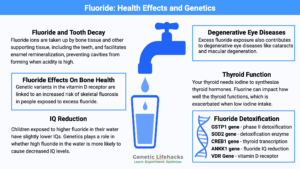
The 2024 National Toxicology Program systematic review concluded that there was moderate confidence in an association between higher fluoride exposure and lower IQ in children. The review examined fluoride exposure from multiple sources, including drinking water, food, beverages and dental products. But the NTP review did not establish that the 0.7 mg/L concentration recommended for U.S. community water fluoridation causes lower IQ. Nor did it establish that every person exposed to fluoride at that level will develop neurological problems.
A person does not live inside a laboratory where fluoride exposure comes from one controlled source. Someone might drink fluoridated water, eat food prepared with that water, drink tea, brush twice daily with fluoride toothpaste and use a fluoride mouthwash.
For a child, the calculation can be even more complicated because swallowing toothpaste is common and children retain a greater proportion of absorbed fluoride than adults. NIH estimates that typical fluoride ingestion from toothpaste varies by age, with children generally ingesting more than adults. The CDC has long recognized that children’s cumulative fluoride exposure can come from multiple sources. It specifically notes that the severity of dental fluorosis is related to the dose, duration and timing of fluoride exposure during tooth development.
That is why looking exclusively at the concentration in drinking water can be misleading if the question is total exposure.
However, there is an equally important caveat. There is currently not enough evidence to say that adding together ordinary fluoride exposures automatically produces a predictable chain of chronic diseases.
Researchers are still trying to determine what exposure levels matter, for whom, at what ages, and through which biological pathways. That uncertainty is precisely what makes the current reassessment important.
What the 2025 Meta-Analysis Found
A major meta-analysis published in JAMA Pediatrics in January 2025 looked at 74 epidemiological studies examining fluoride exposure and children’s IQ.
The overall result was an inverse association: higher fluoride exposure was associated with lower IQ scores.
Of the 74 studies, 52 were classified as having a high risk of bias and 22 as having a low risk of bias. Most were conducted outside the United States, particularly in China, India, Iran and Mexico. No studies in the analysis were conducted in the United States.
When researchers looked specifically at fluoride measured in drinking water, the overall association was no longer statistically significant when exposure was restricted to concentrations below 1.5 mg/L.
But there was another finding that complicates the picture.
Among the studies classified as low risk of bias, the inverse association remained statistically significant even when the water-fluoride exposure was restricted below 1.5 mg/L.
The authors ultimately concluded that there were still limited data and uncertainty about the dose-response relationship at lower concentrations and called for additional prospective studies. That is a very different conclusion from saying either “fluoride is proven dangerous” or “0.7 mg/L has been proven completely harmless.”
Why Is the U.S. Reconsidering Fluoride?

On August 3, 2026, the U.S. Environmental Protection Agency released its protocol for an expedited human-health toxicity assessment of fluoride under the Safe Drinking Water Act. The EPA has not declared fluoride unsafe, nor has it ordered communities to stop fluoridating their water. The CDC’s recommended concentration remains 0.7 mg/L.
What has changed is that the federal government is taking another look at the scientific evidence.
That matters because community water fluoridation has been public-health policy for decades. If the evidence is being reassessed, the question is no longer simply whether critics of fluoridation are right or wrong. It is whether existing policy adequately reflects what scientists now know about fluoride exposure.
The policy landscape is already shifting. Utah became the first U.S. state to prohibit community water fluoridation in 2025, followed by Florida. Other states and communities continue to debate the issue.
Meanwhile, major dental and public-health organizations continue to support fluoridation because of fluoride’s established role in preventing tooth decay.
So the picture is not one of governments suddenly discovering that fluoride is dangerous. It is a long-standing public-health policy being reconsidered while the evidence remains contested.
But Why Is Fluoride in So Many Products?
The corporate side of the story needs its own clarification.
It would be inaccurate to claim that companies routinely add fluoride to food because it is cheaper. There is no strong evidence supporting that broad claim.
Fluoride is primarily used in dental products because it has a specific purpose: preventing and reducing tooth decay.
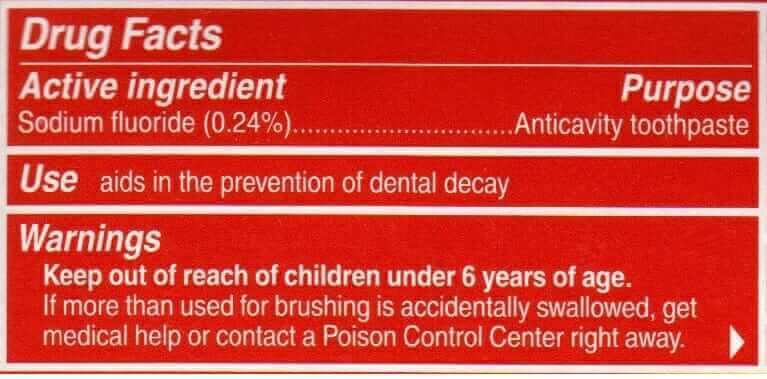
Companies such as Colgate-Palmolive and Procter & Gamble, through brands including Colgate and Crest, sell fluoride toothpastes that use ingredients such as sodium fluoride and stannous fluoride.
The commercial logic is fairly straightforward. Fluoride is effective, inexpensive and supported by decades of dental research.
But fluoride is not the only substance being investigated for cavity prevention.
What Are the Alternatives?
One of the most prominent alternatives is hydroxyapatite, a calcium-phosphate mineral structurally similar to the mineral found in tooth enamel.
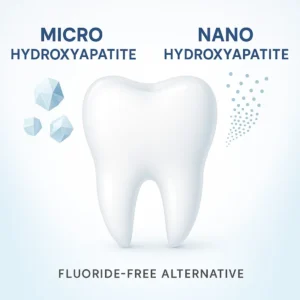
Recent systematic reviews have found growing evidence that hydroxyapatite toothpaste can help prevent and remineralize early dental caries. Some research has found comparable outcomes to fluoride toothpaste in specific populations and measures, although the evidence base is considerably smaller than the one supporting fluoride.
Arginine is another ingredient being studied for its potential role in preventing dental caries. Other approaches include calcium-phosphate compounds and bioactive glass.
These alternatives matter because they demonstrate that fluoride is not the only possible technology for protecting teeth.
But they should not be presented as proven universal replacements. Fluoride has a much larger and longer-established evidence base, and researchers are still determining how well alternatives perform across different populations and levels of dental-caries risk.
The real question is therefore not simply, “Why don’t companies use something else?”
It is:
Can alternatives provide comparable dental protection while reducing concerns about systemic fluoride exposure?
That is a question the market and scientific community are still answering.
The Question We Should Actually Be Asking
The fluoride debate has spent decades asking:
Is 0.7 mg/L safe?
Perhaps the better question is:
How much fluoride is a person actually exposed to over time, from all relevant sources, and what does the evidence tell us about the health effects at those cumulative exposure levels?
That question is harder to answer and requires looking beyond the water supply.
It means examining food and beverages made with fluoridated water, naturally fluoride-rich foods such as tea, toothpaste, mouthwash, supplements and other sources of exposure. It means considering age, body size, swallowing behaviour, kidney function and the duration of exposure.
And it means being honest about what scientists know and what they do not.
There is no evidence that every person drinking water at 0.7 mg/L is accumulating enough fluoride to become sick.
There is also no scientific basis for pretending that 0.7 mg/L represents a person’s entire fluoride exposure. It doesn’t.
The U.S. EPA’s decision in August 2026 to accelerate its human-health assessment means that one of the central questions is being reopened.
The outcome may ultimately reaffirm current policy.
It may lead to changes, or it may reveal that some concerns apply primarily to particular populations and exposure levels rather than to fluoride exposure generally.
For now, the most factual conclusion is also the most uncomfortable one:
We know fluoride can prevent tooth decay. We know excessive and prolonged exposure can cause harm. We know people encounter fluoride through more sources than drinking water alone. And we are still working to understand where the line between benefit and risk falls for different people.
That is the part of the fluoride story worth watching. Whether a public-health system built around a single concentration in drinking water is adequately accounting for the total exposure people receive everywhere else.