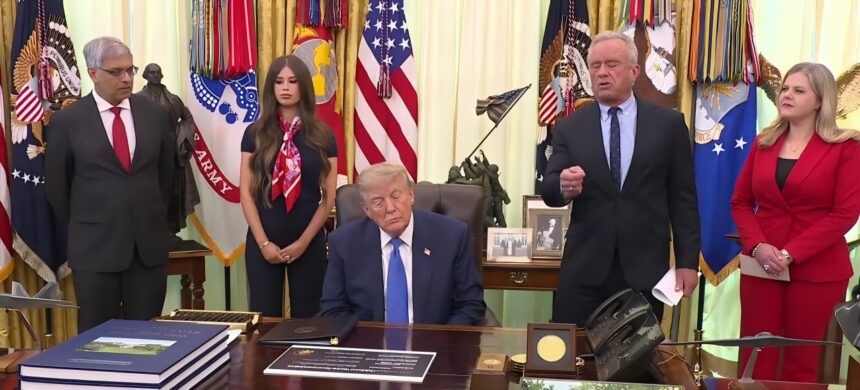
President Donald Trump during the White House executive-order signing event on August 10, 2026.
In a move that marks a definitive shift in the United States’ approach to pediatric public health, President Donald Trump signed an executive order on the 10th of August and on Wednesday, August 13, 2026, the document was filled for public inspection, fundamentally overhauling the nation’s childhood vaccination guidelines. And by August 14th it was scheduled for official publication in the Federal register.
The order, titled “Delivering Gold Standard Childhood Vaccine Recommendations for Americans,” effectively removes the requirement for universal childhood vaccination against three major categories of disease: Hepatitis B, Influenza, and SARS-CoV-2 (COVID-19).
A Decisive Departure from Universal Policy
The executive order directs the Centers for Disease Control and Prevention (CDC) and the Department of Health and Human Services (HHS) to update the Advisory Committee on Immunization Practices (ACIP). This action builds on a broader schedule revision announced earlier this year by Health Secretary Robert F. Kennedy Jr., signaling a sustained pivot away from the “mass vaccination” strategies that dominated public health policy over the previous decade.
Under the new guidelines, the blanket recommendation that all American children receive routine shots for influenza, hepatitis B, and the pandemic-era coronavirus vaccine has been rescinded. Instead, the administration is moving toward a model focused on targeted protection and individualized medical choice.
The Details of the Overhaul
According to the order and the signing remarks delivered by the President at the White House, the changes focus on three primary areas:

Hepatitis B: The routine universal requirement for the Hepatitis B vaccine at birth and during the pediatric well-child visits has been removed. The new framework suggests a move toward a risk-based approach rather than universal mandate.
Influenza (Flu): The annual recommendation for all children to receive the flu shot has been eliminated from the standard childhood schedule.
COVID-19: The order formally removes the standing recommendations for universal COVID-19 vaccination for children, ending the era of mandatory pandemic-related shots for pediatric patients.
The Controversy of the MMR Split
Perhaps the most clinically controversial aspect of the order is its impact on the MMR (Measles, Mumps, and Rubella) vaccine. The guidelines now move toward separating the MMR combination shot into individual doses rather than administering them together.
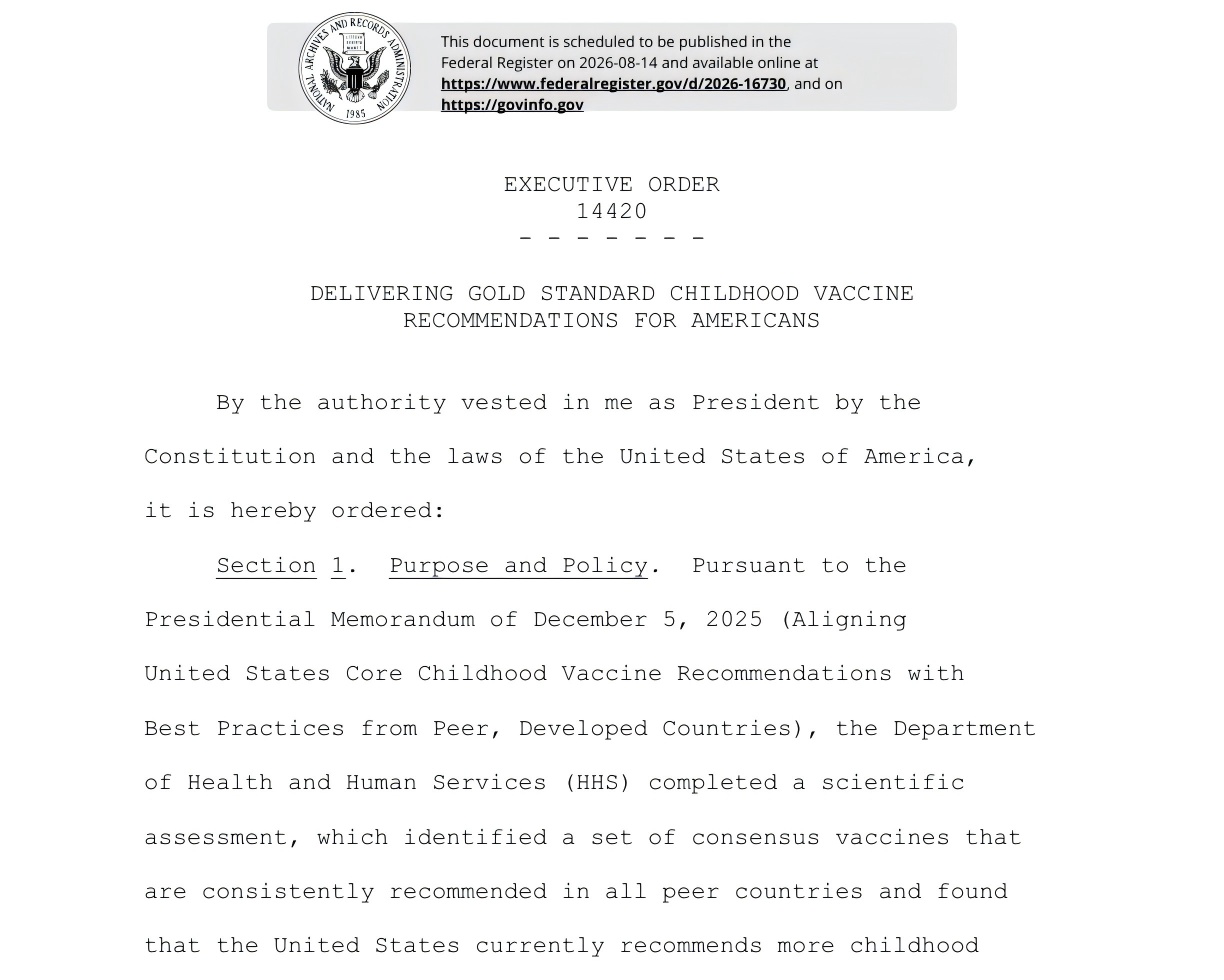
Excerpt from the public-inspection copy of Executive Order 14420.
This shift was confirmed in the order’s specifics and heavily scrutinized by medical experts. The CDC’s own legend on page 15 of their accompanying documentation confirmed the change, stating plainly that the MMR shot contains three separate doses, one for each disease.
This change is designed, by the administration’s logic, to reduce the “load” on a child’s immune system and to provide more granular data on how children react to individual components. However, it represents a significant change to the supposed “standard pediatric protocol” established decades ago.
Pushback from Medical Authorities
The announcement triggered immediate and sharp criticism from the nation’s leading medical bodies.
The American Academy of Pediatrics (AAP) issued a swift condemnation, labeling the recommendation to split the MMR shots as “dangerous” for public health. Experts argue that splitting the vaccine increases the number of painful needle sticks required by pediatric patients and potentially decreases vaccination compliance.
The CIDRAP (Center for Infectious Disease Research and Policy) offered a critical analysis of the executive order, suggesting that the administration’s approach ignores decades of epidemiological data. Their op-eds highlighted that many peer nations maintain high childhood vaccination rates through education and public trust, rather than mandates, and warned that the US’s sudden pivot could have long-term consequences for herd immunity.
The Rationale: “Gold Standard” Protection
Despite the backlash, the Trump administration stands firmly by the order. The rhetoric from the White House emphasizes a return to what they term the “gold standard” of care.
Speaking at the signing, President Trump highlighted the removal of Hepatitis B, COVID-19, and Influenza as key victories for parents and medical freedom. The administration’s overarching argument is that a single, rigid schedule imposed on every child regardless of genetic makeup or existing health conditions is not only medically unsound but also a violation of bodily autonomy.
What This Means for American Families
For the first time in recent memory, the United States government is officially stepping back from the role of universal pediatric immunization.
While the vaccines themselves are not “banned” medical professionals can still administer them, but the federal government is no longer pushing them as a mandatory part of the educational system or universal public health policy.
Parents across the country will now have to navigate a healthcare system that is in a state of transition. The next few months will see the CDC roll out the new guidelines, and it will be up to individual pediatricians and families to decide how these changes fit into their healthcare journeys.
Whether this move is hailed as a long-overdue correction which we think it is, or feared as a dangerous step backward, it will define American health policy debates for years to come. And should remain an example to other nations.