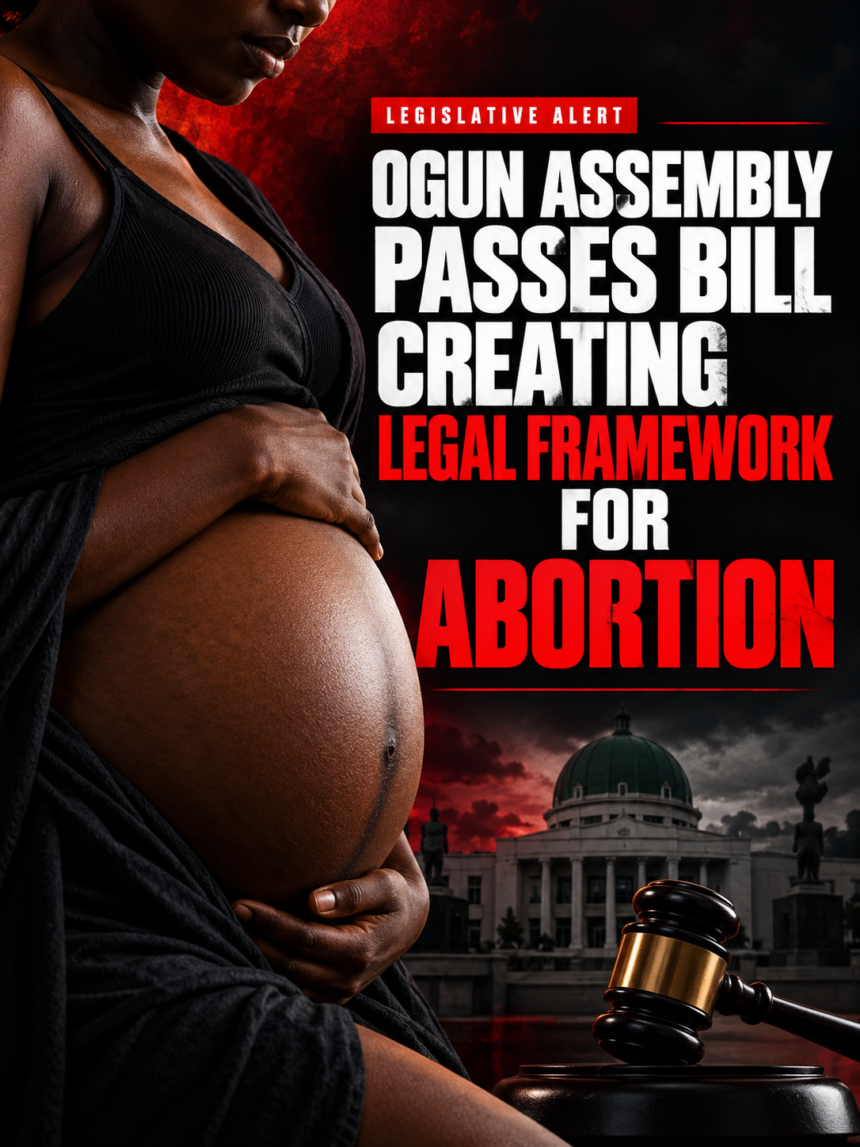
The Ogun State House of Assembly has passed a controversial new bill that would establish a legal framework for the termination of pregnancies in the state under specified circumstances.
Known as “H.B. No. 036/OG/2026 – Ogun State Safe Termination of Pregnancy Law, 2026,” the legislation moves Ogun State toward formally defining circumstances in which an abortion may legally be performed by qualified medical practitioners in approved health facilities.
Although presented by lawmakers primarily as a measure to reduce maternal deaths, promote safe motherhood and protect reproductive health rights, a central provision of the legislation is the establishment of conditions under which pregnancies may be legally terminated.
During earlier deliberations on the bill, its sponsors stated that the legislation was intended to provide a clearer legal and medical framework for terminating pregnancies in recognised circumstances, including situations where a pregnant woman’s life is at risk. Lawmakers also cited cases involving rape and medically high-risk pregnancies while defending the proposal.
The bill was passed during Thursday’s plenary at the Ogun State House of Assembly Complex in Oke-Mosan, Abeokuta, under the leadership of Speaker Oludaisi Elemide.
Its passage followed the presentation of the House Committee on Health’s report by its Chairman, Wahab Haruna, who moved that the report be adopted. Chief Whip Hon. Omobola Bakare seconded the motion, after which members approved it through a voice vote.
Lawmakers subsequently considered the proposed law clause by clause during the Committee of the Whole House.
Babatunde Tella later moved for the bill to proceed to its third reading, with Lukman Adeleye seconding the motion. Members again supported the proposal through a voice vote, after which Clerk and Head of Legislative Service Mr. Sakiru Adabakin formally read the bill for the third time.
With the Assembly’s passage complete, Speaker Elemide ordered that a clean copy be forwarded to Ogun State Governor Prince Dapo Abiodun for assent.
The governor’s decision is now crucial.
If he signs the bill, Ogun State will have a specific statutory framework regulating circumstances in which pregnancy termination may be lawfully carried out, a controversially significant development in the state’s approach to abortion and reproductive-health law.
The debate surrounding the legislation goes beyond its stated maternal-health objectives to more fundamental questions surrounding abortion, the protection of unborn life, reproductive rights, medical ethics and the extent to which state law should permit the termination of pregnancy.
This bill raises serious questions about possible foreign policy influence.
At a time when many citizens are grappling with poverty, unemployment, rising living costs, weak social protections and other urgent economic pressures, it is legitimate to ask why legislative energy is being directed toward expanding the legal framework for abortion rather than aggressively addressing the conditions making everyday survival increasingly difficult.
Supporters may insist that termination would only be permitted under defined legal and medical circumstances. But that assurance does not remove the concern that such exceptions could, in practice, become loopholes, gradually stretching far beyond the narrow conditions initially presented to the public.
That is precisely why this legislation must not be treated as a routine health-policy measure.
On a broader level, the message it risks sending is simple: abortion, once prohibited except within very limited legal boundaries, is becoming increasingly normalised through legislation.
Policy researchers, lawmakers, legal practitioners, civil-society organisations and concerned citizens should therefore examine this bill with far greater scrutiny. They should ask who shaped its policy direction, what organisations or interests promoted it, what funding or advocacy networks may be connected to it, and whether Ogun State is importing a reproductive-health agenda developed outside Nigeria without sufficient regard for the country’s cultural, ethical and demographic realities.
For those already concerned about Western population-control and depopulation policies promoted across parts of the developing world, this legislation will inevitably raise further alarm.
The issue is therefore bigger than the language of “safe termination.”
It is about the direction of public policy, the value placed on unborn life, the possibility of legal exceptions becoming wider gateways, and whether Nigeria is gradually adopting reproductive policies whose long-term consequences have been nothing short of damning.
The final step now rests with Governor Dapo Abiodun.
And with that decision comes a responsibility that goes far beyond simply signing another bill into law.