

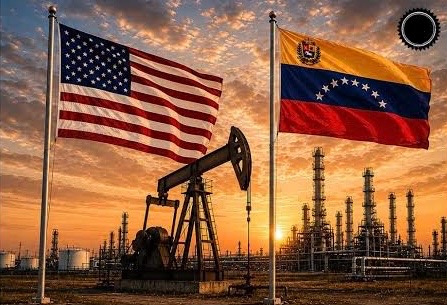
The United States and Venezuela have reached a sweeping energy agreement that could fundamentally reshape the global oil market and Washington’s relationship with Caracas.
US President Donald Trump has described the arrangement as the “biggest oil deal in world history,” saying American interests will gain majority control over more than 65 billion barrels of Venezuela’s proven oil reserves. Venezuela’s interim President Delcy Rodríguez, meanwhile, says the agreement will last 25 years and involve the development of 17 strategic oilfields.
The deal is designed to revive Venezuela’s badly weakened oil industry. The country currently produces about 1.25 million barrels of crude per day, but the agreement aims to raise production to more than 1.5 million barrels per day. Caracas estimates that the project could attract around $100 billion in private investment and generate approximately $209 billion in revenue for the Venezuelan state, based on an assumed oil price of $65 per barrel.
But beneath the enormous numbers lies a deal with consequences that extend far beyond the oil industry.
What does the deal mean for the United States?
For Washington, one of the biggest advantages is energy security.
The United States has been looking for ways to strengthen its oil supply after years of disruptions caused by geopolitical conflicts. President Trump has now said Venezuelan crude will also be used to replenish America’s Strategic Petroleum Reserve, which has fallen to around 290 million barrels—its lowest level in more than four decades.
More Venezuelan oil entering the market could eventually put downward pressure on American fuel prices. President Trump has promoted the agreement as a way to lower gasoline prices for Americans.
However, consumers should not expect an immediate reduction at the pump.
Venezuela’s oil infrastructure requires enormous investment and rehabilitation before production can rise substantially. Experts have also pointed out that there is still uncertainty about exactly how quickly the additional crude can reach international markets.
The agreement could nevertheless give Washington something even more valuable than cheaper fuel: greater control over a huge source of oil located in its own hemisphere.
Venezuela could receive billions, but at what cost?
For Venezuela, the deal could provide an economic lifeline.
Years of economic crisis, mismanagement, sanctions and declining investment have left the country’s once-powerful oil industry operating far below its potential. Foreign capital and technology could help rebuild production, infrastructure and export capacity.
If the projected investment and government revenue materialise, Venezuela could use the money to rebuild roads, electricity networks, oil infrastructure and other parts of its economy.
But there is a major political question: who ultimately controls Venezuela’s oil wealth?
Acting President Rodríguez insists that Venezuela retains sovereignty over its natural resources. Critics, however, argue that giving American interests significant control over oilfields and production could amount to an unprecedented expansion of US influence over the country’s most valuable national asset. Protests have already erupted in Caracas over the agreement.
The geopolitical implications could be even bigger
The agreement marks a dramatic transformation in US-Venezuelan relations.
For years, Washington and Caracas were bitter adversaries. Venezuela’s oil industry was heavily affected by US sanctions, while successive American administrations opposed the Venezuelan government.
Now, the two countries are entering an arrangement in which American interests could play a central role in developing Venezuela’s enormous petroleum reserves.
Washington is not simply gaining access to oil, It could be affirming American influence over a strategic energy producer in the Western Hemisphere.
Could this affect global oil prices?
Potentially, but not overnight.
Venezuela possesses the world’s largest proven crude oil reserves, estimated at more than 300 billion barrels. Yet possessing enormous reserves does not mean producing enormous quantities of oil.
Increasing Venezuelan output will require new wells, upgraded refineries, pipelines, electricity and other infrastructure.
If Venezuela eventually succeeds in significantly increasing production, additional barrels entering the international market could increase supply and place downward pressure on global oil prices.
That could benefit countries that depend heavily on imported crude, including developing economies that are particularly vulnerable to high energy costs.
But it could also put pressure on other oil-producing countries. A significant increase in Venezuelan production would add another major supplier to an already politically sensitive global oil market.
A warning sign for oil-producing nations?
Perhaps the most controversial implication is how the agreement could affect resource sovereignty.
Supporters see the deal as a commercial partnership that could rescue Venezuela’s oil industry and create enormous economic opportunities.
Critics see something very different: a powerful country gaining substantial influence over another nation’s most valuable natural resource.
That debate could resonate far beyond Venezuela.
For oil-producing nations across Africa, Latin America and the Middle East, the agreement raises a broader question: How much control should foreign governments and corporations have over a country’s natural resources in exchange for investment and technology?
The answer could shape how future energy partnerships are negotiated.
The biggest question is whether the promises become reality
Despite the enormous headlines surrounding the agreement, many important details remain unclear. No complete public text of the agreement has been released, and questions remain about financing, ownership, investment, production timelines and the precise structure of American control.
That makes the deal potentially transformative, but also difficult to evaluate fully at this stage.
If the promised investment arrives, Venezuelan production increases and billions of dollars flow into the country’s economy, the agreement could become a turning point for Venezuela.
For the United States, it could strengthen energy security and expand its influence over one of the world’s largest oil reserves.
But if the arrangement deepens Venezuela’s dependence on Washington or fails to deliver meaningful benefits to ordinary Venezuelans, it could instead become a source of political conflict for years to come.
Either way, the consequences of this deal are likely to extend far beyond the oilfields of Venezuela.
Sources:
Reuters.com, The Washington Post, Al Jazeera