

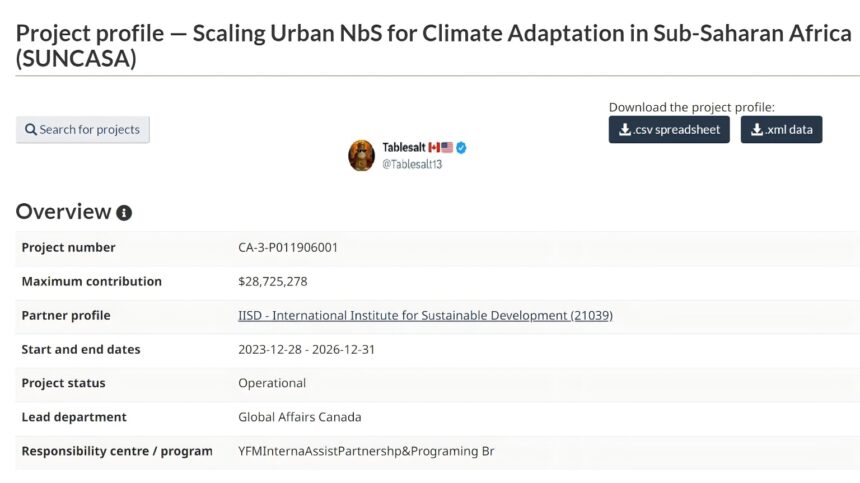
A recent decision by Global Affairs Canada has sparked debate and disbelief among taxpayers who are already struggling under the weight of a mounting national debt. Canada is, reportedly, funneling nearly CAD $28 million into programs in South Africa, Rwanda, and other African nations under the title: “Gender-responsive Nature-based Solutions for Climate Adaptation.”
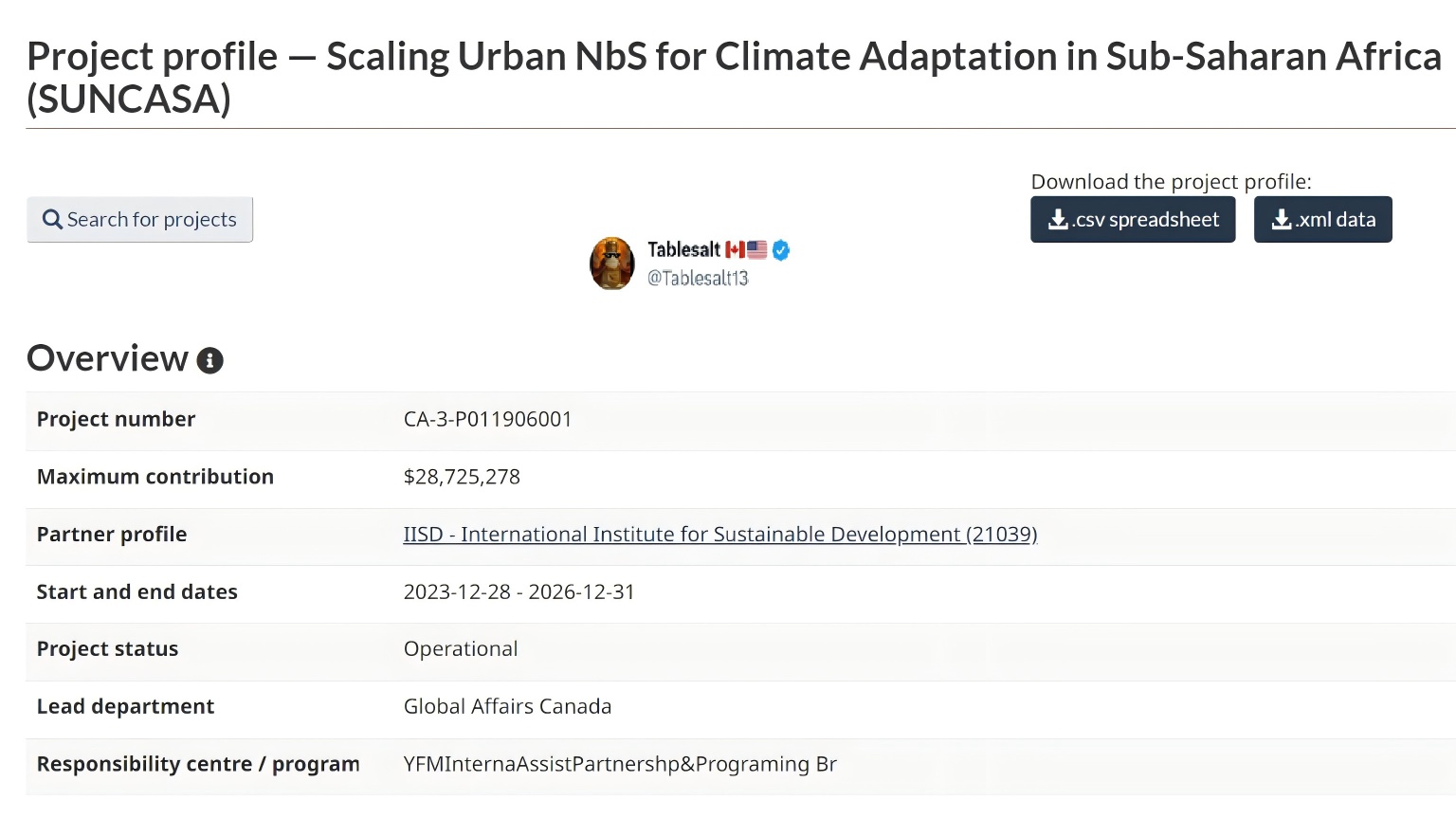
Project profile, Scaling Urban NbS for Climate Adaptation in Sub-Saharan Africa (SUNCASA).
For the average Canadian facing a cost-of-living crisis, this headline sounds not just out of touch, but fundamentally misplaced. How can a country allegedly “broke” and drowning in red ink find billions to send abroad?
It’s Not About the Money in the Bank
The first thing to understand about the claim that Canada is “broke” is that it is true. Canada’s federal debt has surpassed $1.47 trillion, translating to roughly $35,517 per citizen and over $43,000 per taxpayer. Government borrowing-to-GDP ratios are climbing, and projections suggest they will remain above 43% in the coming years.
This however means that every dollar spent abroad is effectively a dollar of debt added to the shoulders of the very taxpayers footing the bill. The deficit spending is structural and relentless.
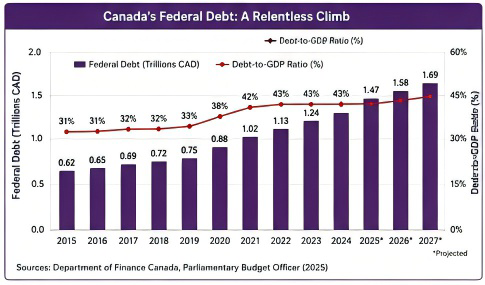
Illustrative visual: Canada’s federal debt and debt-to-GDP trend.
The Fronting
The perception is that Canadian funds are being routed through international frameworks like the World Resources Institute (WRI) and the Partnering for Climate fund. Critics argue that Ottawa uses these international vehicles to push an ideological agenda without proper parliamentary scrutiny or accountability to Canadian voters.
The specific focus on “gender-responsive” policies has drawn particular ire. To many, it appears that Canadian taxpayers’ money is being used not just for infrastructure, but to export a specific social and political ideology to sovereign nations across the African continent.
Where is the Priority?
While Global Affairs Canada touts that this $28 million initiative will impact 2 million people and create “climate resilience,” the contrast with domestic reality is jarring. There are crumbling hospitals, strained social services, and a housing crisis in major cities like Toronto and Vancouver.
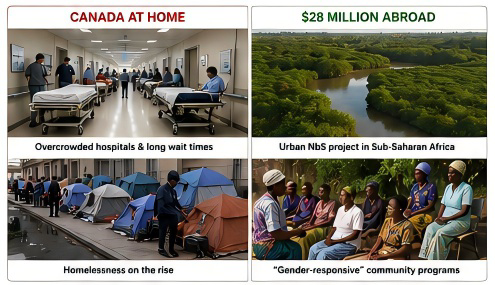
Illustrative comparison of domestic pressures in Canada and nature-based climate adaptation programming abroad.
When you add it all up, roughly a $2.3 trillion debt burden including provincial obligations the question is no longer just “can Canada afford it?” The question is a moral one: Why are they prioritizing ideological globalist experiments over the survival and prosperity of the people?
What the Phrase ‘Gender-responsive nature-based solutions’ Actually Mean?
We would have to look at the two halves of that title separately to understand the full picture:
First, “Nature-based Solutions” (NbS): This is environmental jargon for using ecology to solve problems instead of concrete. Instead of building a gray concrete wall to stop flooding, a so called “nature-based solution” might involve restoring a wetland, planting mangroves, or “greening” a city to absorb water.
“Gender-responsive”: This is where the ideology enters. It means the project explicitly prioritizes women to address perceived gender inequality. The logic used by these globalist organizations (like the World Resources Institute) is that women are disproportionately affected by climate change (e.g., they often walk farther for water or care for the sick) and are excluded from decision-making.
Put together: “Gender-responsive NbS” means you are using ecological restoration (like planting trees or restoring wetlands) to stop flooding, but the project must have specific goals for women’s empowerment, safety, and leadership. It’s not just about “stopping the water” in quote, it’s about “stopping the water while transforming the social structure.”
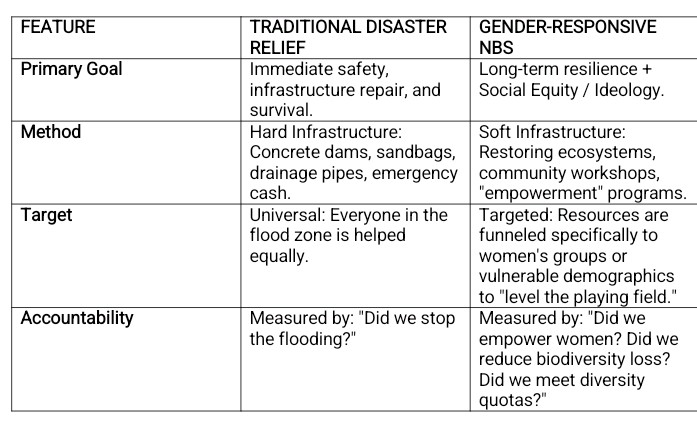
How It Differs from Traditional Disaster Relief
This distinction is why many taxpayers are angry. Traditional relief is functional; “Gender-responsive NbS” is simply social engineering.
The Practical Problem
1. Slower Results: Building a concrete drainage ditch takes a few months and solves the flood. Restoring a natural wetland ecosystem (NbS) takes years to mature, and the flooding might get worse.
2. Ideological Friction: The traditional model is “if you are in danger, you get help.” The NbS model is “you only get help if you fit the criteria for this specific solution.”
3. The “Globalist” Agenda: The Great Reset connection, this method turns climate adaptation into a tool for social control. It forces local governments and communities to adopt specific Western social ideologies in exchange for survival funds. We know the outcome, History has repeatedly shown us.
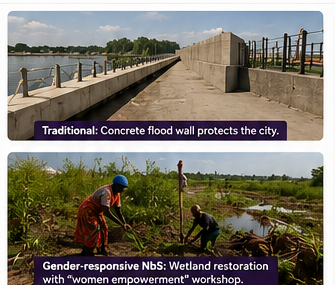
Illustrative comparison: conventional hard flood infrastructure and wetland-based adaptation.
So, when Canada sends $28 million for this, they aren’t just buying cement and hiring construction crews. They are funding a complex, decade-long social experiment in cities like Johannesburg and Kigali, using taxpayer money to advance an ideological framework that often feels alien to the local cultures they claim to help.