
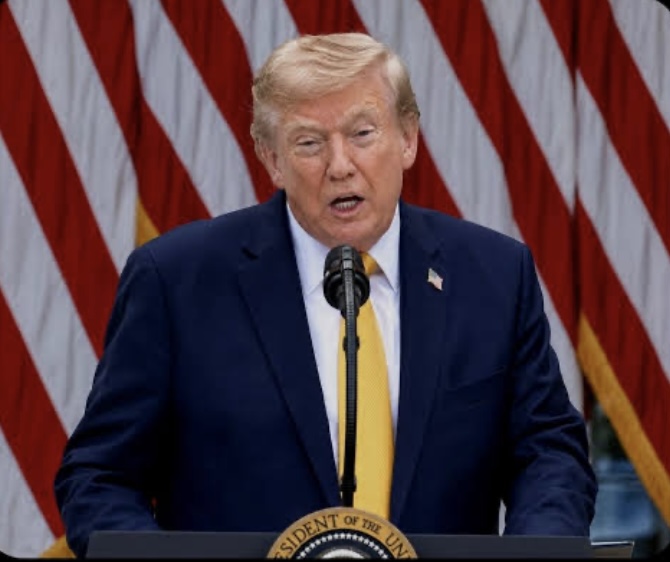
President Donald Trump has delivered a blunt message to America’s public schools: when it comes to a child’s identity, parents, not teachers, counselors or school administrators should be in charge.
And this time, he did not leave much room for interpretation.
During a White House back-to-school event on Monday, Trump warned that schools telling children they are “trapped in the wrong body” could be committing child abuse.
“Every public school in America is now on notice,” Trump declared.
The remark immediately became one of the most talked about moments of the event, but it was not an isolated statement. It fits into a broader campaign by Trump’s administration to put parents back at the center of decisions involving their children.
The president’s message is simple: schools educate children; parents raise them.
Trump has repeatedly argued that schools should not be able to keep major information about a child from that child’s parents. His administration has now moved beyond speeches and promises, using federal enforcement powers to challenge school districts over policies involving gender identity and parental access to student records.
In July, the U.S. Department of Education announced action against Anne Arundel County Public Schools in Maryland and Ann Arbor Public Schools in Michigan. Federal officials accused the districts of policies that could prevent parents from accessing information about their children’s gender identity. The department warned that continued violations could lead to legal action and the loss of federal funding.
Then came another development in Kansas.
On August 25, the Education Department announced that Topeka Public Schools had agreed to change policies that federal officials said interfered with parents’ rights. Two other Kansas districts; Olathe Public Schools and Shawnee Mission Public Schools were facing further federal enforcement after declining to voluntarily comply.
That is why Trump’s latest warning carries more weight than a viral social-media clip might suggest.
The administration is actually putting pressure on school districts.
Education Secretary Linda McMahon has repeatedly echoed the president, arguing that parents have the primary authority and responsibility when it comes to their children. At Monday’s White House event, she said the administration was working with the Justice Department to ensure that “no school district ever has more power over a child than their own parents.”
This is the heart of the issue.
They are not asking schools to stop educating children. They are asking a much more basic question: Who gets to make the biggest decisions about a child—the people who sent the child to school, or the institution the child attends for several hours a day?
Trump’s answer is unequivocal.
Parents.
The president has also tied the issue to his wider education agenda, which includes school choice, reducing federal control over education and eliminating what his administration describes as ideological programs from classrooms. At the Rose Garden event, Trump argued that American education needs to return to fundamentals and that parents should have greater freedom over where and how their children are educated.
The controversy surrounding gender identity in schools has become one of the biggest cultural battles in American education. But Trump’s latest intervention suggests that his administration intends to turn that battle into something more concrete: federal policy with consequences.
And that may be the most important part of his warning.
“Every public school in America is now on notice,” Trump said.
For school districts that have believed they could make these decisions without involving parents, the message from Washington could hardly be clearer.
The Trump administration is saying that era is over.
Parents are being put back in the driver’s seat and President Trump intends to keep his foot on the gas.